
Publication Source : www.spine-health.com
A slipped disc refers to an intervertebral disc of the spine that has lost its normal shape and/or consistency. The altered shape occurs when the disc’s soft inner material (nucleus pulposus) bulges or leaks out of its external fibrous covering (annulus fibrosus).1 Several medical terms, such as herniated, ruptured, torn, bulged, or protruding disc may be used interchangeably with a slipped disc.
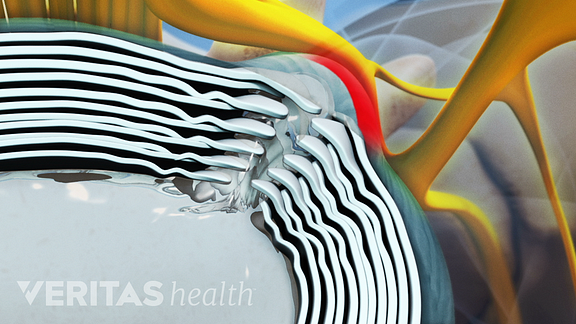
A herniated disc occurs when material from a disc’s inner core leaks out. Watch: Herniated Disc Video
Your intervertebral discs are spinal shock absorbers and help transfer loads evenly. When a slipped disc occurs, the entire motion segment—including the adjacent vertebrae, connective tissue, blood vessels, and nerves may be affected.2 Slipped discs are more common in the lower back, followed by the neck.3
How a slipped disc occurs
The two most common causes for a slipped or herniated disc are3:
- Natural degeneration of the disc, which causes the nucleus pulposus to become less hydrated and weaken with age.
- Trauma to the disc, which may occur due to lifting a heavy load using incorrect posture or from external forces, such as, a whiplash injury.
Rarely, disorders of the connective tissue of the spine or alterations in the shape of the spinal vertebrae, such as short pedicles, may cause a slipped disc to occur.3
See Lumbar Herniated Disc: Causes and Risk Factors
Contained vs. uncontained discs
When the nucleus pulposus of a slipped disc leaks into the tears of the annulus fibrosus but does not exit beyond the disc’s outermost layer, it is called a contained disc.
If the nucleus pulposus leaks outside a disc completely, it is called an uncontained disc.
Types of pain from a slipped disc
A slipped disc may cause pain within the local area, such as your neck or back, or in a distant location, such as your arm and/or leg.
Some slipped discs may not cause pain. It is possible for a herniated disc to be painless and/or spontaneously resolve itself without treatment.4
Nerve pain
Herniation commonly occurs toward the side and back of the disc, where the annulus fibrosis is relatively thinner. This part of the disc is also close to the spinal nerve roots and can cause3:
- Mechanical compression of these nerve roots, which may result in nerve pain and/or weakness in your arm or leg, depending on the site of compression
- Chemical irritation of the nerve roots due to the leaking of inflammatory substances from the nucleus pulposus
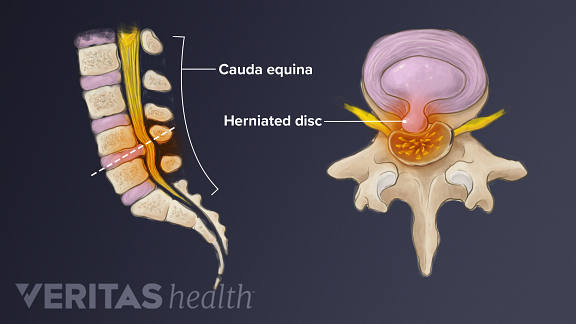
In severe herniation of the disc, spinal cord or cauda equina compression may occur.
Chronic localized pain
A slipped disc may cause localized, chronic pain, such as lower back pain5 or neck pain.6 This type of pain is also called discogenic pain.
Watch Discogenic Lower Back Pain Video
Motion segment instability
A slipped disc due to degeneration may cause instability in the spinal motion segment, resulting in pain and abnormally increased or decreased mobility.2
Read more: Anatomy Of Nerve Pain
The importance of a correct diagnosis
A doctor can accurately diagnose a slipped disc and rule out other causes of similar pain, such as tumors, fractures, or infection. A correct diagnosis also helps formulate an effective treatment plan to control your symptoms and prevent the progression of nerve or spinal cord damage.
See Understanding the Clinical Diagnosis of a Herniated Disc
Learn more:
Typical Symptoms of a Herniated Disc
3 Telltale Signs You Have a Slipped or Bulging Disc
References
- 1.Herniated Disc – Symptoms, Causes, Prevention and Treatments. American Association of Neurological Surgeons website https://www.aans.org/en/Patients/Neurosurgical-Conditions-and-Treatments/Herniated-Disc. Accessed June 01, 2020.
- 2.Inoue N, Espinoza Orías AA. Biomechanics of intervertebral disk degeneration. Orthop Clin North Am. 2011;42(4):487–vii. doi:10.1016/j.ocl.2011.07.001
- 3.Gossman W, Ngnitewe Massa R, Mesfin FB. Disc Herniation. [Updated 2019 Jul 13]. In: StatPearls [Internet]. Treasure Island (FL): StatPearls Publishing; 2019 Jan-. Available from: https://pubmed.ncbi.nlm.nih.gov/28722852/
- 4.Gugliotta M, da Costa BR, Dabis E, et al. Surgical versus conservative treatment for lumbar disc herniation: a prospective cohort study. BMJ Open. 2016;6(12):e012938. Published 2016 Dec 21. doi:10.1136/bmjopen-2016-012938
- 5.Fujii K, Yamazaki M, Kang JD, et al. Discogenic Back Pain: Literature Review of Definition, Diagnosis, and Treatment. JBMR Plus. 2019;3(5):e10180. Published 2019 Mar 4. doi:10.1002/jbm4.10180
- 6.Peng B, DePalma MJ. Cervical disc degeneration and neck pain. J Pain Res. 2018;11:2853–2857. Published 2018 Nov 14. Available from: https://www.ncbi.nlm.nih.gov/pmc/articles/PMC6241687/
